
Tonbridge and Malling wants to stop counting a disability benefit as income when it works out council tax support. Have your say by 11 October.
Tonbridge and Malling Borough Council wants to stop treating a disability element of Universal Credit as income when it decides how much council tax support a household gets. The change would take effect on 1 April 2027, and the consultation on it closes on Sunday 11 October.
The element in question is the limited capability for work and work-related activity payment, usually shortened to LCWRA. It is paid to Universal Credit claimants who have been assessed as unable to work or to prepare for work because of illness or disability.
Under the council’s current scheme, that money counts as income. The more income the council counts, the less council tax reduction a household gets. Under the proposal it would be disregarded entirely.
Why it is being proposed
This is a gap left behind by the move off the old benefits. The council says that under the legacy benefits, “equivalent support was disregarded when calculating entitlement to Council Tax Reduction”: that is the support component of Employment and Support Allowance. Universal Credit’s LCWRA element does the same job, but nothing in the current scheme disregards it.
So a resident who was moved from ESA onto Universal Credit without any change in their health could end up with less help towards their council tax than they had before.
The council’s own equality impact assessment puts it plainly. The aim is:
To remove a loss of protection that can arise when a working-age resident moves from legacy Employment and Support Allowance (ESA) to Universal Credit.
There is already a way round it. Residents can apply separately for a discretionary discount under section 13A of the Local Government Finance Act 1992. The assessment says the point of the change is to make the protection automatic instead, “reducing delay, administrative burden and the risk that eligible residents do not seek discretionary support.”
The council gives two different estimates
The consultation page and the supporting assessment do not say the same thing about the size of this.
- The consultation page says “fewer than 100 households may be affected” and puts the cost at “under £50,000 per year”.
- The equality impact assessment says the affected group is “approximately 50 households, to be confirmed” and models the extra cost at “just over £6,000” a year.
The assessment is the more recent and more detailed document, and it flags its own uncertainty: the council should “validate the modelling and affected caseload as far as practicable” before the final decision. Whichever figure holds, the cost falls on the wider council tax base rather than on other claimants, because nobody’s reduction goes down as a result.
What it is worth to a household
The council’s working-age scheme is a banded one. Your weekly income puts you in one of five bands, and each band comes with a fixed discount off your council tax bill. The bands in the draft 2027/28 scheme are identical to those in the scheme running now. Only the disregard is new.
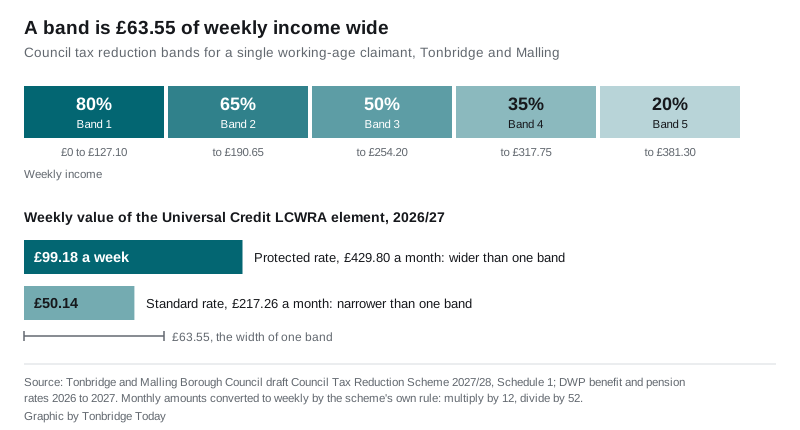
Each band for a single claimant is £63.55 of weekly income wide. That is what makes the disregard worth something, because for most of the people it is aimed at, the LCWRA element is bigger than that.
For 2026/27 the government pays LCWRA at two rates: £429.80 a month for claimants who were already on it before 2026, for those who meet the severe conditions criteria and for those who are terminally ill, and £217.26 a month for everyone else. The scheme converts monthly Universal Credit to a weekly figure by multiplying by 12 and dividing by 52, which makes those £99.18 and £50.14 a week.
Take £99.18 out of a single claimant’s assessed income and, unless they are already in band 1, they move up at least one band and in some cases two. Take £50.14 out and they move up one band or none, depending on where they sat.
A band is worth 15 percentage points of your bill. On the band A charge for Tonbridge of £1,632.36, one band is £244.85 a year and two bands are £489.71. At band D, £2,448.53, the same steps are £367.28 and £734.56. Our council tax bands page has the full charge for every part of the borough.
What it means for you
If you get Universal Credit with the LCWRA element and you live in Tonbridge and Malling, this is aimed at you, and the consultation is the point at which to say so.
- The consultation runs to 11 October 2026. It opened on 29 August. Responses go through the council’s online questionnaire.
- Nothing changes before April 2027, and only if the council adopts the scheme.
- You do not have to wait. The section 13A discretionary route is open now, and part of the council’s case for the change is that having to apply separately puts eligible people off. Apply through the benefits team on 01732 844522 or at benefits@tmbc.gov.uk.
- Nobody is worse off under the proposal. The assessment records that no claimant’s reduction would fall as a result.
- It is not a full exemption. Even in band 1, the most generous band, the scheme covers 80% of the bill. Everyone of working age relying on it pays at least a fifth of their council tax.
One thing the change does not touch: the scheme still cuts off entirely if you have more than £16,000 in savings, and pension-age council tax reduction is set by government rather than by the borough, so it is unaffected.
Sources
- Tonbridge and Malling Borough Council, Consultation on a proposed change to the Council Tax Reduction Scheme
- Tonbridge and Malling Borough Council, Draft Council Tax Reduction Scheme 2027/28 (Schedule 1 bands; Schedule 3, paragraph 74, the proposed disregard)
- Tonbridge and Malling Borough Council, Equality Impact Assessment
- Tonbridge and Malling Borough Council, Council Tax Reduction Scheme from 1 April 2026
- Department for Work and Pensions, Benefit and pension rates 2026 to 2027
- Tonbridge and Malling Borough Council, council tax charges 2026/27
Have your say