
Small HMOs near Tonbridge station, in central Snodland and on one East Malling estate will need planning permission. A six-week consultation opens today.
Turning a family house into a small shared house will need planning permission in parts of Tonbridge, Snodland and East Malling. Tonbridge and Malling Borough Council’s Cabinet approved the change on Tuesday 6 October. A six-week public consultation starts today.
At the moment, a landlord can let a house to between three and six unrelated people without asking anyone. That is a “small HMO”, or house in multiple occupation. The council’s new Article 4 Direction removes that right in three areas.
The council’s decision record shows the recommendations as approved, subject to call-in, the short window in which councillors can ask for a decision to be looked at again. (Tonbridge and Malling Borough Council, decision D260098CAB)
The three areas
The maps put before Cabinet cover:
- Tonbridge: the High Street from Bordyke south to the station; the streets west of the station around Douglas Road, as far as Sussex Road school; and the area south of the station between Quarry Hill Road and St Mary’s Road, down to Baltic Road. These are parts of Judd, Vauxhall, and Cage Green and Angel wards.
- Snodland: a strip along Malling Road from Constitution Hill south past St Katherine’s Lane to Ham Hill and Brook Lane.
- East Malling: the Carnation Crescent estate between the A20 London Road, Winterfield Lane, Chapman Way and New Road. The council’s map labels this one Leybourne.
The rest of Tonbridge, including Trench and Higham, is not included.
Why these streets
The council commissioned DHA Planning to assess the borough. Its evidence paper, issued on 22 September, says Tonbridge has the highest number of known and likely HMOs. Most sit close to the station, to the south of it, and along the northern stretch of the High Street.
The paper points to the terraced houses south of the station, and particularly east of Quarry Hill Road, as where growth is most likely. Many of those streets have on-street parking only, and its site visit noted bins kept at the front of houses. House prices there are lower than in most of the borough.
In Snodland, the paper says the terraced streets west of the High Street and the larger houses at Ham Hill could be converted. It also flags Snodland as an “overspill” risk from Medway, which already restricts HMOs. In East Malling, it describes a densely built mid-20th-century estate with two known HMOs, limited parking and some of the lowest house prices in the borough. (HMO Review and Evidence Paper)
The paper is open about how few HMOs the borough has. It says the council is “not seeking to restrict the number of HMOs” but to keep control of their standard. It also says crime and anti-social behaviour in these wards cannot be directly linked to HMOs.
How many HMOs there are
The numbers in the evidence paper:
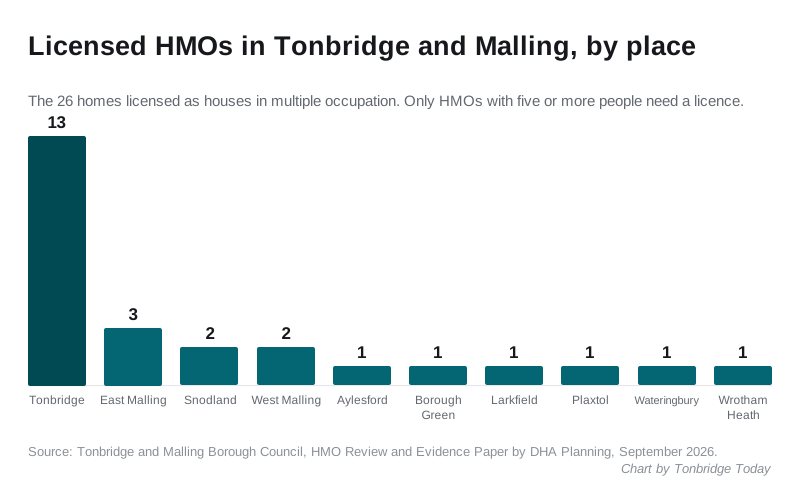
- 26 homes licensed as HMOs, 13 of them in Tonbridge
- 37 that the council estimates should be licensed, so some are not
- 165 HMOs in council figures for 2023-24, which “may now be 171”
- 74 homes exempt from council tax because students live there
- more than 200 units of this kind of housing in total, about half of them thought to be in and around Tonbridge
Only HMOs with five or more people need a licence, which is why the licensed count is so much lower than the total.
The paper also records that the cost of a room to rent rose by 56% between 2014 and 2022, against 23% for a three-bedroom home. It expects that gap to bring more pressure for HMO conversions.
Places considered and left out
The paper looked at Kings Hill, Larkfield, Aylesford North and North Downs, and Walderslade, and recommends none of them for now.
Kings Hill has no known HMOs. Larkfield and Aylesford were judged unlikely to see problems because most homes have off-street parking and decent gardens.
Walderslade, on the borough’s northern edge next to Chatham, drew the most public interest. The paper says two properties there that raised concern are linked to possible asylum housing. One has applied for HMO use, which on its own “would be insufficient” to justify a direction. It recommends monitoring the area for overspill from Medway instead.
Separately, on 30 September the council’s leader, Matt Boughton, and two Cabinet members wrote to the Home Secretary about a Walderslade property used as asylum dispersal accommodation. The letter says the council believes it was occupied before a valid HMO licence application could be assessed. It asks the Home Office to review the actions of the provider, Clearsprings Ready Homes. (Tonbridge and Malling Borough Council)
When it takes effect
Not for at least a year. The council chose a non-immediate direction, which only comes into force 12 months after notice is published. That avoids paying compensation to anyone already setting up an HMO.
The Cabinet report sets out the timetable:
| Step | When |
|---|---|
| Consultation opens | Friday 9 October 2026 |
| Consultation closes | Six weeks later, about 20 November |
| Results back to Cabinet | December 2026, if no significant issues are raised |
| Direction in force | 12 months after the notice is published |
(Cabinet report, 6 October 2026)
The council will not write to every home in the three areas, because there are too many. Instead it plans:
- a notice in the local press
- a notice at the council offices at Gibson Building, Kings Hill
- the consultation on its online portal, with a press release
- at least two site notices in each ward for six weeks
- letters to HMO licence holders and other interested groups
When we checked on Friday morning, the council’s consultations page did not yet list it.
What it means for you
- If you own a house in one of the three areas: from the date the direction takes effect, letting it to three to six unrelated sharers will need planning permission. Large HMOs, with more than six people, already need it everywhere.
- If you are a tenant in a shared house now: nothing changes for existing HMOs. The direction applies to new changes of use.
- If you live nearby: the consultation is your chance to say whether the boundaries are right. The paper accepts that the areas could be widened later if evidence changes.
- If you rent a room: the council’s own evidence says HMOs are “a legitimate and needed form of housing”. The direction is about where and to what standard, not a ban.
The draft Local Plan, out for consultation until 25 October, has its own HMO policy too, Policy H9, which would apply where planning permission is needed. How to comment on the plan is on our Local Plan consultation page, and the wider picture on our planning news page.
Have your say