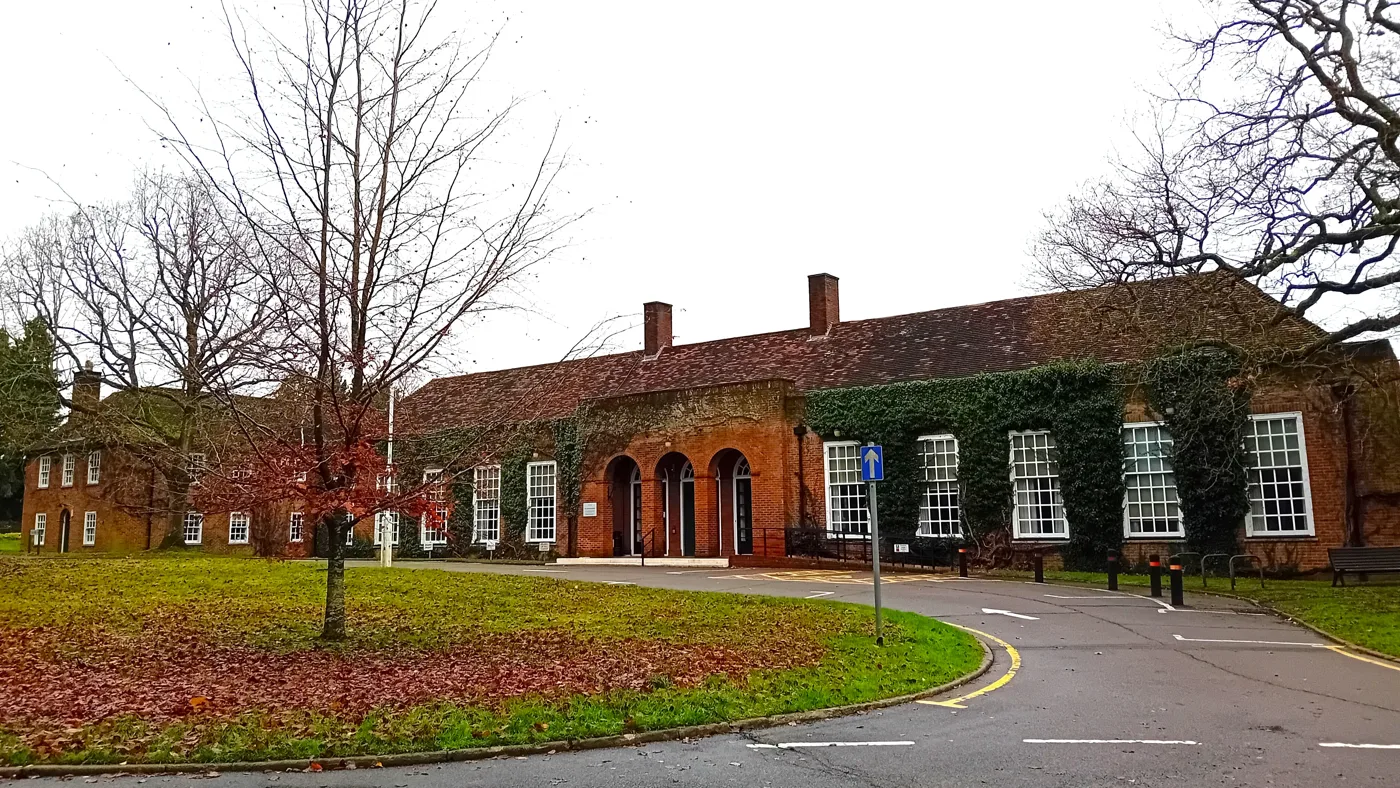

From 31 October, councillors can no longer call in planning applications. Two people will decide what reaches committee. Council votes on the change on Tuesday.
Borough councillors in Tonbridge and Malling lose the power to call planning applications in to committee on 31 October. From that date, most applications will be decided by council officers. Only two people will be able to send one to the Planning Committee: the committee’s chair and the council’s Head of Planning, and only if they both agree.
The change is national, not local. But Full Council has to rewrite its own rulebook to match, and it votes on that on Tuesday 20 October. (Report to Full Council, 20 October 2026)
The new rules are set out in the Town and Country Planning (Discharge of Local Planning Authority Functions) (England) Regulations 2026. They apply to every planning authority in England from 31 October.
What changes on 31 October
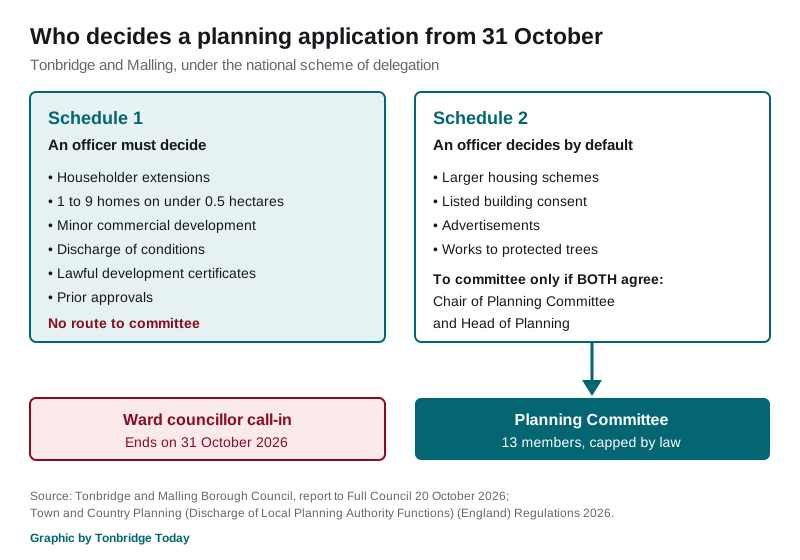
The regulations split applications into two lists.
Schedule 1: an officer must decide. No councillor can send these to committee. The council’s report lists them, including:
- householder applications, such as extensions and loft conversions
- minor housing schemes of one to nine homes on a site under half a hectare
- minor commercial development
- discharge of conditions and non-material amendments
- certificates of lawfulness
- prior approval for permitted development
- most reserved matters, unless the outline permission is for at least 500 homes
Schedule 2: an officer decides unless both gatekeepers agree. This covers larger housing schemes, listed building consent, advertisements and works to protected trees. The government’s guidance says the “overriding presumption” is that these go to officers too.
A Schedule 2 application can reach committee only if the nominated member and the nominated officer agree it raises “issues of economic, social or environmental significance to the local area”, or significant planning matters. If they do not refer it, an officer must decide it.
Applications in which the council, a councillor or an officer has an interest get the same two-person test.
Who the two gatekeepers are
The report recommends the posts below. Substitutes cover absences.
| Role | Post | Substitute |
|---|---|---|
| Nominated member | Chair of Planning Committee | Vice-Chair of Planning Committee |
| Nominated officer | Head of Planning | Development Manager |
The Planning Committee’s membership page lists Councillor Wendy Palmer as chair and Councillor Dave Davis as vice-chair.
The regulations also cap a planning committee at 13 members. Tonbridge and Malling’s already has exactly 13, so it does not need to shrink.
How September’s schemes would fare
The Planning Committee met on 16 September, and reconvened on 24 September, to decide five housing schemes. The officer reports say why each one was there. Two of them reached committee only because a ward councillor called them in.
Land east of Town Hill, West Malling. Eight self-build homes on about 1.5 hectares. The report says Councillor Dean called it in over “housing delivery, countryside location and impacts upon the West Malling Conservation Area”. Officers recommended approval. Councillors refused it unanimously. (Officer report, 25/00767/OA)
Paris Farm, The Rocks Road, East Malling. 35 homes on about 2.4 hectares. The report says it came to committee “at the request of Councillor Tatton”, because the site is not allocated in the current Local Plan. Councillors approved it, 9 votes to 3. (Officer report, 25/01325/FL)
Both sites are bigger than half a hectare, so both are Schedule 2 under the new rules. A ward councillor’s request would no longer be enough to send either to committee. They would have gone only if the chair and the Head of Planning both judged them significant. Otherwise an officer would have decided Town Hill, on a recommendation to approve.
By contrast, the 300-home outline scheme at Bull Lane, Eccles, was at committee “due to the strategic nature of the development”. Schemes of that size are the kind the new referral test is meant to catch. (Officer report, 25/00925/OAEA)
Our report of the September decisions is here.
Why the council has no choice
The report is blunt about the alternative. If a planning committee decides an application that the rules say an officer must decide, after 31 October, the government’s guidance warns the decision “may be subject to judicial review”.
The only other option the report considered was to change nothing. It rejects that because the regulations apply regardless.
The Secretary of State must review the regulations and publish the findings by 31 October 2028.
What it means for you
- Your comments still count. An officer deciding an application has to weigh the same planning objections a committee would. Comment on the council’s planning portal as before.
- Asking your councillor to call an application in will no longer work. They can still pass on concerns, and the chair and Head of Planning can still refer a Schedule 2 scheme if they agree it is significant.
- Extensions and small schemes next door will never go to committee. If you object to a neighbour’s householder application, the officer’s decision is final, apart from the applicant’s right of appeal.
- The Planning Committee meets on 28 October, three days before the change. Its agenda has not yet been published.
- Council meets at 7.30pm on Tuesday 20 October in the Council Chamber at Gibson Drive, Kings Hill. The agenda is on the council’s website.
For the wider picture on housing in the borough, see our Tonbridge planning news page.
Have your say