
The borough's highest monthly total in at least two years. Every extra claimant since 2024 is under 25 or over 50, and the 25 to 49 band has shrunk.
The number of people claiming unemployment-related benefits in Tonbridge and Malling reached 2,095 in August, the highest figure in any month of the past two years.
That is 2.5% of residents aged 16 to 64. The figures were published by the Office for National Statistics on 15 September. (ONS claimant count via nomis)
The headline has barely moved in six months. It has sat at 2.5% since March. What has changed is who is in it.
The whole increase is at the two ends of working age
Two years ago, in August 2024, the borough had 1,845 claimants. It now has 2,095, a rise of 250. Split that by age and the 250 resolves into three separate movements:
- aged 18 to 24: up 220, from 270 to 490
- aged 50 and over: up 100, from 425 to 525
- aged 25 to 49: down 70, from 1,145 to 1,075
The middle band is much the largest, and it is the only one that has improved. It is now at its lowest August level in the series. Everything driving the borough’s total upwards is happening either side of it.
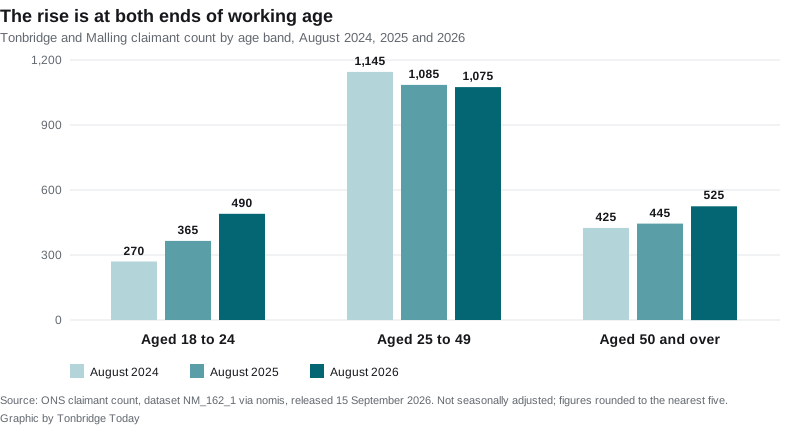
The same pattern holds over one year. Between August 2025 and August 2026 the total rose by 195: the under-25s account for 125 of that, the over-50s for 80, and the 25 to 49 band fell by 10.
The youngest claimants have moved fastest of all. Those aged 18 to 21 have more than doubled in two years, from 150 in August 2024 to 310 now.
Under-25s were 14.6% of the borough’s claimants in August 2024. They are 23.4% of them now.
No Kent district has seen a steeper rise in young claimants
Every district in Kent has more under-25s claiming than it did two years ago. None is close to this borough.
| District | Aged 18 to 24, Aug 2024 | Aug 2026 | Change |
|---|---|---|---|
| Tonbridge and Malling | 270 | 490 | +81.5% |
| Sevenoaks | 220 | 305 | +38.6% |
| Dartford | 410 | 550 | +34.1% |
| Tunbridge Wells | 225 | 300 | +33.3% |
| Medway | 1,355 | 1,775 | +31.0% |
| Maidstone | 650 | 815 | +25.4% |
| Gravesham | 555 | 655 | +18.0% |
| Folkestone and Hythe | 430 | 505 | +17.4% |
| Thanet | 890 | 1,040 | +16.9% |
| Canterbury | 675 | 780 | +15.6% |
| Ashford | 490 | 565 | +15.3% |
| Dover | 505 | 525 | +4.0% |
| Swale | 710 | 725 | +2.1% |
Across the South East as a whole the under-25 count rose 25.0% over those two years, and across the UK 18.1%. Tonbridge and Malling is running at more than three times the national rate.
On the headline measure the borough still looks comfortable. At 2.5% of 16 to 64 year olds it is joint second lowest in Kent, level with Tunbridge Wells and behind only Sevenoaks on 2.3%. Thanet is highest at 5.4%, Gravesham 4.3% and Medway 4.2%. The South East average is 3.1% and the UK 3.9%.
That comfortable headline is exactly why the age split is worth publishing. A borough can sit near the bottom of a county table and still have the county’s fastest-growing problem inside it.
A correction to our July figures
We published the July count on 21 August as 2,085 overall, with 465 claimants aged 18 to 24. ONS now records July as 2,060 and 460.
Neither of those is an error on our part or theirs. The Universal Credit part of the count “allows for revisions to the data for one previous month”, so the most recent month in any release is the one most likely to move by the next one. (ONS Claimant Count QMI) We will keep flagging these rather than quietly restating the numbers.
What the claimant count is, and is not
- It is not the unemployment rate. ONS is explicit: the count “does not attempt to measure unemployment, which is a concept defined by the International Labour Organisation (ILO) as all those who are out of work, actively seeking work and available to start work”. It measures people “claiming benefits principally for the reason of being unemployed”.
- Some of the people in it have jobs. The count includes Universal Credit claimants “who are considered to be jobseekers, that is claimants who are required to seek work in order to remain eligible for benefits”. Low earnings can keep someone in that group.
- Students are largely not in it. ONS notes that people in full-time education “will not generally be eligible for unemployment benefits while searching for work, which particularly affects 18- to 21-year-olds”. So the rise in that band is not students signing on.
- The figures are rounded. Cross-tabulations like the age splits above are “rounded to the nearest five for publication”, so read the percentages as close approximations.
- They are not seasonally adjusted. That is why every comparison here is August against August.
What it means for you
If you are under 25 and job-hunting in this borough, the plain reading is that you are competing with roughly 220 more people your own age than someone in your position faced in the summer of 2024, in a place where the market for people aged 25 to 49 has quietly improved.
There is one local scheme running now that is aimed squarely at this.
Tonbridge and Malling Borough Council and Runway Training launched the People and Skills Project on 2 September. It runs until December 2026 and offers free training in three sectors: agri-tech, construction and social care. Runway Training will deliver 21 half-day skills taster sessions across the borough, with follow-up support afterwards.
It is open to everyone, with a stated focus on young people, on those not in education, employment or training, and on residents of Trench in north Tonbridge, Aylesford, Snodland and East Malling. Anyone interested can email adultskills@runwaytraining.co.uk. (Tonbridge and Malling Borough Council)
Work-search support itself is not a borough council service. Jobcentre Plus and the Department for Work and Pensions run that, and Kent County Council runs careers and skills provision for young people. The borough council’s part is housing and council tax support.
The next release, covering September, is due in October. September is the month that will show whether the summer’s jump was school and college leavers passing through or the trend continuing.
Related
- Tonbridge and Malling claimant count: under-25s up 72%: the July figures and the two-year picture across Kent.
- Tonbridge house prices: what the borough’s housing market is doing alongside this.
- Council tax support and the LCWRA change: what the benefit changes mean for local bills.
- Tonbridge council tax bands: what your band costs this year.
Sources
- ONS claimant count, dataset NM_162_1 via nomis, reference months August 2024, August 2025 and August 2026, released 15 September 2026, for Tonbridge and Malling (E07000115), the eleven other Kent districts, Medway, the South East and the United Kingdom. Males and females combined, not seasonally adjusted.
- ONS Claimant Count Quality and Methodology Information, for the definition, the eligibility rules, the rounding and the revisions policy.
- Tonbridge and Malling Borough Council, “Programme launches to help young people with careers and training”, published 2 September 2026.
Have your say